May 2026: Collaboration Abounding!

Collaboration Abounding!

This month’s roundup features collaboration.
Sometimes, collaboration begins and then takes years to develop. Other times, it’s quick and leads to answers for patients. The work in between is what will eventually lead us to a cure. In the meantime, we are grateful to be a resource to the global community of researchers, clinicians, and patients who need connections and ideas.
Currently, the DADA2 Foundation is focused on preparing for our 10th Anniversary: Pursuing What’s Possible. If you would like to join in the efforts, email us! Throughout the next six months, we’ll be highlighting the global network built over this past decade, the scientific discoveries that are underway, and the patients whose lives we are working to change.
We are right on the edge of so many significant advancements, and we look forward to honoring the journeys of each patient as well as the hard work of each researcher. Please let us know if you want to be part of the effort by emailing info@dada2.org.

Chip Chambers, M.D., Founder & President, DADA2 Foundation
Prevalence Studies Reach Major Milestones
Today, the global community of DADA2 researchers and clinicians has identified approximately 800 DADA2 patients. But one study shows that there could be 35,000 patients throughout the world. How can we estimate that?
The process is called a prevalence study, and the one in which the DADA2 Foundation participated to arrive at our estimate recently celebrated a milestone. Prevalence studies, specifically this one, use population data and a specific methodology to determine prevalence of a disease.
For DADA2, we were part of the beginnings of this kind of work with the Massachusetts Institute of Technology/Broad Institute as well as Dr. Pui Lee at Boston Children’s Hospital in the United States. Using a series of experiments, we determined our estimate: that 1 in 236 people in the world may be a carrier and 1 in 222,000 may have the disease, which means that 35,000 actual patients might exist worldwide.
Today, the Broad Institute – which is world-renowned and started from work among scientists at Harvard University and the Massachusetts Institute of Technology (MIT) – uses that same process. It is now called the GeniE platform and recently published a paper in Medrxiv to show their findings for 18 other diseases. Prevalence studies are an important tool in spurring diagnosis and treatment options since pharmacology companies want to know how many patients are affected by a disease when they consider new treatments.
Collaboration is the key to solving rare diseases. We applaud the milestone reached by the team at Broad and are grateful to have been part of the initial work that led to this next level of research for rare diseases alongside our participation in the Chan Zuckerberg Rare as One grant.
Our Latest Patient Gathering: Gene Therapy Updates
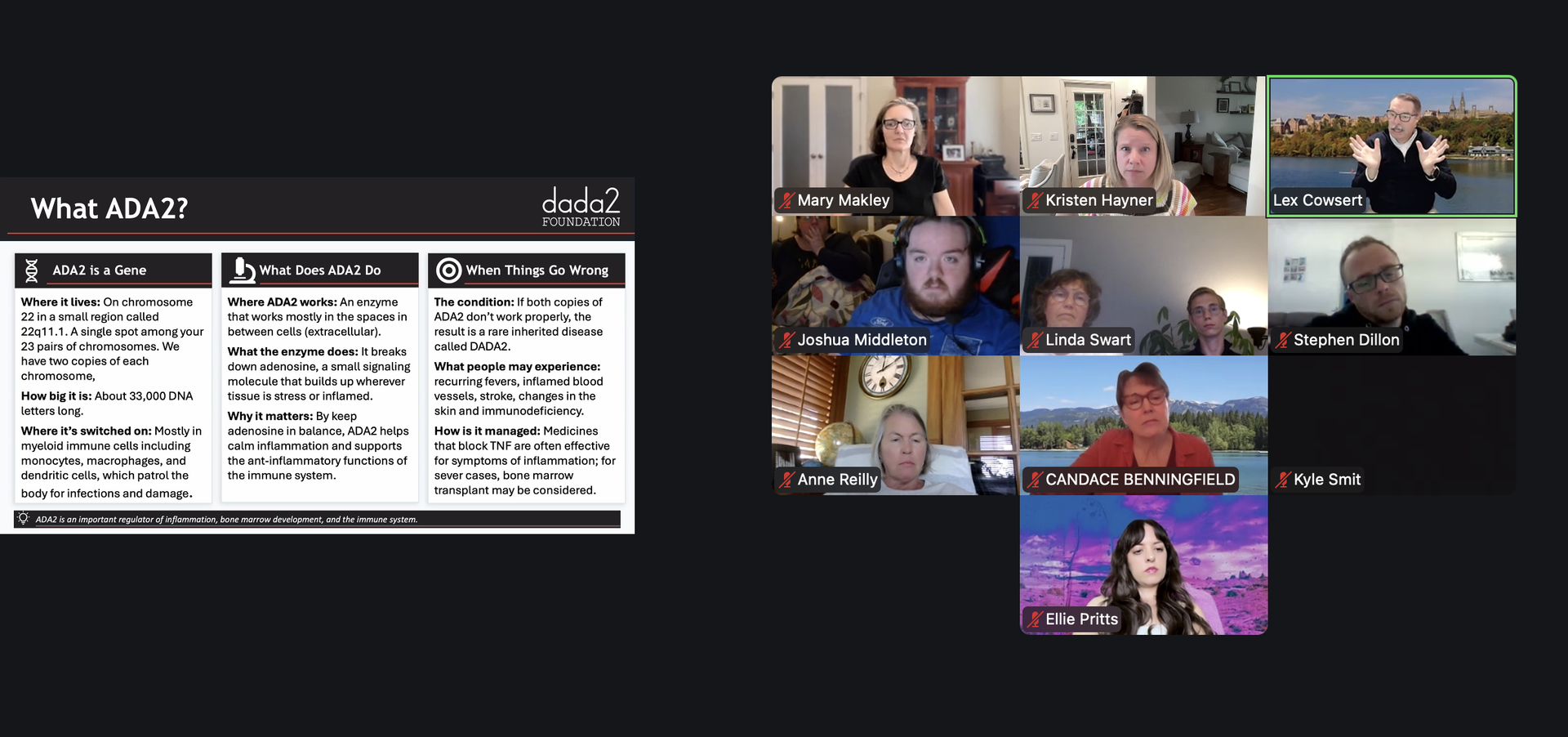
“When will genetic therapy be available and how can I sign up?”
“How does genetic therapy even work?”
These questions, and so many more, were answered during our second patient gathering of the year, held online on May 20. With nearly 20 patients/family members in attendance from nearly 10 countries, we spent more than an hour hearing from DADA2 Foundation’s Chief Scientific Officer Lex Cowsert, Ph.D., on updates from global gene therapy efforts. More than 40 additional patients requested the recording, which can still be requested by emailing info@dada2.org. A transcript of the Q&A is available here.
When will our next patient gathering be and what will we cover? Stay tuned. We will schedule one once we ask patients for their feedback on future topics. Watch for an email later this summer!
Patient Story: Layan’s Story in Egypt
Rare disease parents are among the toughest people and are also their children’s greatest champions.
Nouran, a mother of a now-diagnosed DADA2 patient Layan, spent 18 months chasing an answer for her infant daughter’s repeated fevers. The first fever came at two months old, then nearly every month for about a year. Diagnosed with a urinary tract infection, gastroenteritis, ear infections, COVID, rashes from an insect allergy, and other diagnoses, her physicians finally tested her for Mediterranean Familial Fever (FMF) which came back positive. But her medications did not stop the fevers, which increased in frequency. Finally, genetic testing was recommended, which took two months to show a positive result for DADA2.
Now a four-year-old, Layan is finally feeling better with her weekly Enbrel injections, and thanks to a few initial rounds of IVIG infusions. She loves her gymnastics class and is an active participant in her life. Nouran found her daughter’s current physician after her own research and motherly intuition led her to the DADA2 Foundation and we were able to connect her to Dr. Walaa Shoman in Alexandria, Egypt.
These are the stories of grit and determination that end in answers, but we wish they happened differently. Our hope is that, one day soon, stories like Layan and her mother Nouran are shorter and more clear, where physicians know more about DADA2 in order to suspect, diagnose, and treat it.
Graphic Design Help Needed!
We are looking for someone with Adobe Illustrator skills to donate some time so that we can lay out versions of our physician brochure in different languages. If you have access to the latest version of the software and are familiar enough to use new text in a template, please reach out to info@dada2.org
Latest Research
Development of a Yucatan Mini-Pig Model for Deficiency of Adenosine Deaminase 2 (DADA2). Tarrant, Teresa, et al. (2026): eCIS2026abstract-48.
Hepatic Manifestations and Response to Treatment in Deficiency of Adenosine Deaminase 2. Shaik, Mohammed Rifat, et al. Liver International 46.6 (2026): e70660.
Advances in the Diagnosis and Management of Vasculitis. Rodríguez-Pla, Alicia. (2026): 176.
First Case of Deficiency of Adenosine Deaminase 2 (DADA2) in Oman With a Novel Mutation: A Case Report. Al Ramadhani, Nasra M., Ruqaiya Al Jashmi, and Safiya Al-Abrawi. Cureus 18.4 (2026).
A Single-Center Study on Childhood Rare Vasculitides: Clinical and Outcome Analysis. Türkmen, Şeyma, Taner Coşkuner, and Betül Sözeri. Turkish archives of pediatrics 61.5 (2026): 388-398.
Functional characterisation of a novel homozygous p. Y227C ADA2 variant in a child with deficiency of adenosine deaminase type 2.” Hong, Y., et al. Clinical and Experimental Rheumatology 2026.