
From Diagnosis to Daily Life: Progress and Stories from the DADA2 Community
Walking the Journey Together

Dear DADA2 Community:
Every time I connect with members of our DADA2 community, I’m reminded that this journey is shared. Each family’s story of searching for answers, finding the right care, and learning to adapt helps guide the work we do together.
In this issue, you’ll read about some exciting progress: a simple handheld tool being developed to speed up diagnosis, newborn screening in the UK that could catch DADA2 before symptoms even begin, and a new course that helps families make sense of health data. You’ll also hear from one family about what it’s like to transition from pediatric to adult care, with thoughtful advice for parents who may soon face the same challenge.
None of this progress happens in isolation. It grows out of a community that shares experiences, supports one another, and pushes for change. Thank you for being part of that community and for continuing to walk this path with us.

Chip Chambers, M.D.
Founder & President, DADA2 Foundation
 Shortening the Journey to Diagnosis
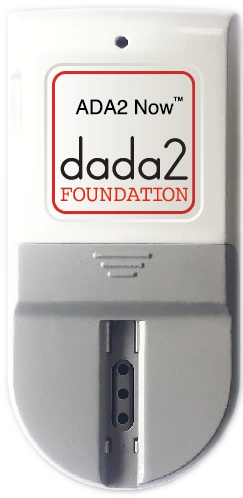 Families affected by DADA2 know all too well the painful uncertainty that comes with searching for a definitive diagnosis. To help shorten that journey, the DADA2 Foundation has invested in the development of a handheld device—dubbed the ADA2 NOW meter—that can measure ADA2 enzyme levels in just 15 minutes using a single drop of blood in a physician’s office. Our Chief Scientific Officer, Lex Cowsert, spent the spring and summer of 2025 refining the second phase of a major grant application to bring this groundbreaking tool into clinical trials. While securing such a large and complex grant is never guaranteed, we are hopeful that this work will pave the way toward faster, easier diagnoses.
While a point of care test for symptomatic patients will be a game changer for diagnosis, the ultimate goal is for patients to be identified even before symptoms appear. And we are thrilled to say that global progress is being made on this front. Newborn screening offers the best chance to diagnose DADA2 early, allowing effective treatments to begin promptly and preventing long-term damage caused by uncontrolled disease. In encouraging news from the United Kingdom, the National Health Service (NHS) announced a plan to expand its newborn screening program over the next decade. As part of this initiative, the NHS will test newborn placenta blood for a wide range of genetic conditions that have effective treatments—and DADA2 will be included in the panel.
Though both of these efforts will take time to bear fruit, they represent tremendous progress. All of this increase in testing will help the Foundation as well as researchers and physicians gain a clearer picture of the global prevalence of DADA2—and, most importantly, spare families the long and difficult road to diagnosis.
 A New Resource for DADA2 Families
 Health data shapes every stage of the rare disease journey. From doctor visits and medical records to quality-of-life surveys and research studies, it guides better care, connects patients with new resources, and fuels the search for effective treatments.
That’s why one of the DADA2 Foundation’s top priorities is fully funding and launching the DADA2 Patient Registry (DPR). By collecting data from both patients and carriers, the DPR will be a vital tool for advancing knowledge and accelerating research.
At the same time, we know that managing and making sense of health data can often feel complicated and overwhelming for patients and caregivers.
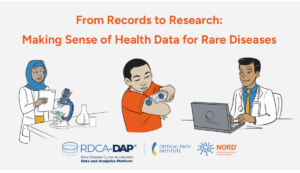
To help, the National Organization for Rare Disorders (NORD®) has created a free, 90-minute online course, “From Records to Research: Making Sense of Health Data for Rare Diseases.”
This course is designed especially for patients, caregivers and advocates in the rare disease community. In just four short modules, you’ll learn:
- How health data is collected from doctor visits, devices and apps, and daily life
- How your data is kept safe and used responsibly in research
- Why health data matters for improving care and developing new treatments
- How you can feel more confident when navigating care, using digital health tools, or considering participation in research
The course is mobile-friendly and requires no technical background and available in both English and Spanish. While the initial modules introduce some U.S. based health terms such as HIPPA, the information pertains to medical data and research across the globe.
The DADA2 Foundation is encouraging our community to take advantage of this free opportunity because understanding your health data can help you feel more empowered in your care and decisions. Click on the button below to begin.

Pediatrics to Adult Care:
Navigating the Transition
 By the time Blake Pearson and his twin sister were born, Susan Pearson knew to watch for strange health issues. The twins’ toddler sister seemed to have more intense reactions to basic colds than her peers. Sure enough, Blake also experienced a long line of mysterious symptoms growing up: purple, aching legs, unexplained rashes, and fevers that never seemed to make sense.
In other ways, Blake was a normal, active kid—fast on the track, excelling in school, and eager to try out for baseball in high school. But when he finished a time trial significantly slower than he should have, Blake felt defeated: “I felt so ashamed and hopeless. We went to all these doctors at Yale but no one understood what was happening.”
Having also watched her two daughters suffer extreme responses to illness, Susan knew something more was going on. Eventually, a pediatric rheumatologist at Boston Children’s Hospital pieced the puzzle together and referred them to Dr. Pui Lee’s care. Dr. Lee was at the beginning of his journey treating many DADA2 patients and publishing widely on the cohort he was discovering. Within weeks, Blake, at age 14, was diagnosed with DADA2, and treatment with Humira brought his symptoms under control. His sisters were both diagnosed as carriers.
 Now in college, Blake is learning to manage his own care—ordering medications, transporting them safely, and keeping them refrigerated on campus. When his dorm lost power, he hurried his medication to the dining hall’s generator-powered fridge, grateful for staff who stepped in to help. “The world’s a great place, people are so helpful,” he says.
For Susan, letting go hasn’t been easy, but she offers advice for parents facing the same transition:
- Make sure your child lists parents on medical release forms.
- Encourage them to use the same walk-in clinic to build a consistent record.
- Keep them with their pediatrician through college if possible.
- Teach them to share their DADA2 status with all providers, even for unrelated procedures.
- Connect with the school’s office of disabilities to ensure your child has necessary accommodations.
As Blake looks ahead to life after graduation, he’s both nervous and excited. As a math major with a minor in computer science, he hopes to work in sports data analytics. About DADA2, he says: “It’s really such a small part of my life now. I used to hide my illness, but now I think it’s an interesting part of who I am. There’s no reason to hide who you are, it’s just genetics!”
 Featured Published Articles on DADA2
Atamyıldız Uçar, Sıla et al, Journal of Clinical Immunology, 15 August 2025
Ariello, Leaonardo E. et al, University of British Columbia These & Dissertations, 21 August 2025
Adenosine deaminase 2 (ADA2) in immune cell development and activation
Bowers,Sarah., Neurological Sciences, 11 January 2025
Pediatric Sneddon syndrome presenting with early-onset liver fibrosis: a rare case report
Awad, Qutaiba N. et al, Oxford Medical Case Reports, 25 August 2025
Roberti, Guilia et al, Journal of Clinical Medicine, 5 September 2025

TAKE ACTION WITH A DONATION
Every dollar you donate help us find more physicians who can diagnose DADA2, ending the diagnostic journey of a patient and starting their journey to health!